
The rules about how your baby sleeps at nursery just changed — and this time, they are part of the law itself.
From 1 September 2026, safer sleep requirements sit in the main body of the Early Years Foundation Stage, the statutory framework every registered nursery in England must follow. They used to live in separate guidance that providers were pointed towards. Now they are written into the framework in detail — and Ofsted inspects against them.
If you are the parent of a baby or toddler, this is probably the nursery topic that matters most to you. So here is exactly what the new rules say, and exactly how rest and sleep work at ME Montessori.
Why sleep is the thing parents ask us about most
You can watch a classroom through a window. You cannot watch your baby sleep — you have to trust the people and the room completely. We know that handing over your child's nap feels bigger than handing over their play, especially in the first weeks. It should. Sleep is when a baby is most vulnerable, and it is where nursery practice has to be most careful.
That is why we welcome the change. Rules we already worked to are now rules everyone must work to.
What the new rules actually require
Paragraph 3.86 of the new framework is specific. For children under two, a nursery must:
- place every child on their back, in their own separate sleep space, on a firm, flat surface
- place babies aged 12 months and under to sleep in a cot only
- keep the sleep space clear: a firm, flat, waterproof mattress and lightweight bedding tucked in below the child's shoulders — or a well-fitted baby sleep bag — and nothing else. No toys, pillows, extra blankets, bumpers, wedges or straps
- where blankets are used, place the child feet to foot at the bottom of the cot, blankets tucked in
- keep children from getting too hot or cold — the recommended room temperature for babies is 16–20°C — and never cover a child's head
- have an adult in the same room for every sleep for babies under six months, check all sleeping children frequently, and keep them within sight and hearing of staff
The framework also requires a separate baby room for under-twos (paragraph 3.87), and points practitioners to NHS advice on sudden infant death syndrome and to The Lullaby Trust, the UK's leading safer sleep charity. Our practice follows Lullaby Trust guidance.
A nap at ME Montessori, from drop-off to wake-up
Rest here is unhurried. Sleep follows each child's own routine — the one you tell us about at settling-in — not a whole-room timetable that expects twenty children to nod off on cue.
Your baby is put down on their back, in their own separate sleep space, in a calm room kept within the temperature range the framework recommends. Once asleep, every child is checked frequently and stays within sight and hearing of our team — because that is what the framework requires, and because it is what any parent would want.
Sleep furniture grows with your child, in three stages:
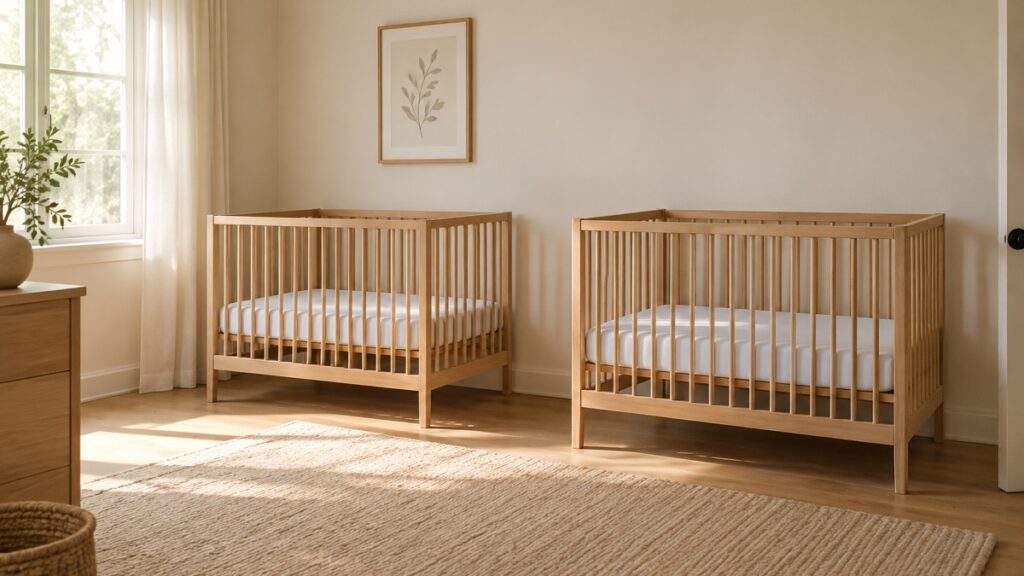
- Under 1s sleep in cots — the framework is clear that babies of 12 months and under must sleep in a cot, and ours do: on their backs, feet to foot, in a clear cot with nothing in it but a tucked-in sheet or a well-fitted sleep bag.
- One- to two-year-olds sleep in wooden sleep pods — their own defined, cosy space, sized for them, in the same calm room.
- Over 2s rest on raised beds — proper little beds for children who are moving towards dropping their nap, with quiet rest always available even on the days sleep doesn't come.
Each stage suits the age: a cot for the months when safe sleep rules are tightest, a snug pod for busy toddlers who need their own territory, a real bed for the preschool years. And because every child has their own separate sleep space — another framework requirement — nobody's nap depends on anybody else's.
What the rules require, and what we do
| The framework now requires | How rest works here |
|---|---|
| Babies on their backs, in their own sleep space, on a firm flat surface | Every child, every sleep |
| Under 12 months in a cot only | Our under 1s all sleep in cots |
| Clear sleep spaces — no toys, pillows, bumpers or loose bedding | Tucked-in lightweight bedding below the shoulders, or a well-fitted sleep bag — nothing else |
| Feet to foot when blankets are used | Standard practice |
| Room temperature 16–20°C, heads never covered | The room is kept within range, and heads are never covered |
| Adult in the room for every sleep for under-6-months; frequent checks for all, within sight and hearing | Built into how the sleep room is staffed, in line with the framework |
| Separate baby room for under-twos | Our baby room has its own dedicated sleep space |
Questions to ask about sleep when you view any nursery
- Can I see the sleep room — during nap time if possible?
- Who settles my baby, and how?
- How often are sleeping children checked, and can I see how it's recorded?
- What does my child sleep in — and what's inside it with them?
Come and see the sleep room
You can read every rule ever written about safer sleep — and we would encourage you to. But the thing that will actually reassure you is standing in a calm room, seeing where your baby would sleep, and meeting the person who would settle them. Come and see it.
✨ Places available — book a private tour today.
📞 07873 403672
📧 [email protected]
🌐 www.memontessorinurseryandpreschool.com
📍 Bedgrove Community Centre, Bedgrove Park, Ambleside, Aylesbury, HP21 9TT